Every custom metal sign is really two products stacked together: the graphics on the surface and the metal underneath. Buyers spend most of their attention on the artwork, but the substrate is what decides whether the sign is still flat, legible, and rust-free in ten years or curling off its screws in two. Three metal families cover almost every order: solid aluminum, aluminum composite panel, and steel. Knowing how they differ in thickness, weight, corrosion, and lifespan is what separates a sign that lasts from one that merely looks good on delivery.
Solid aluminum, and why the gauge matters more than the metal
Solid aluminum is the default sign substrate for good reason: it does not rust. Unlike steel, aluminum has no iron to oxidize into red rust; instead it forms a thin, self-protecting oxide layer that shrugs off weather. The variable that actually matters is gauge, the sheet thickness, and it spans a wide range. Light gauges of .032 and .040 inch suit small wall signs, real-estate yard signs, and parking or directional markers. A medium .063 inch handles pole-mounted signs and anything likely to get bumped. Heavy .080 inch is the standard for most regulatory road signs and larger formats, and extra-heavy .100 and .125 inch are reserved for large highway panels, high-wind locations, and overhead or bridge signage.
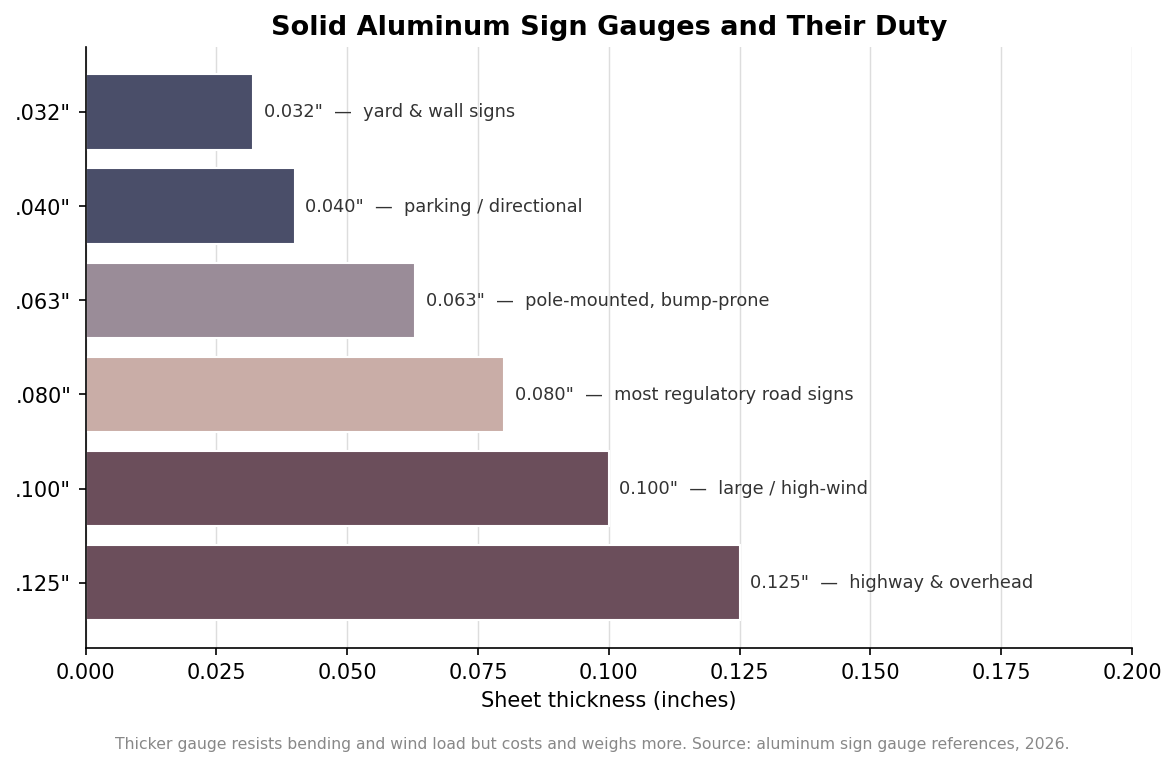
Thicker is not automatically better. A heavier gauge resists bending and wind load, but it also costs more, weighs more, and needs sturdier mounting hardware. Specifying .125 inch for a small lobby sign wastes money; specifying .040 inch for a large sign in an open, windy lot invites flexing and cracking at the fasteners. Match the gauge to the size and the wind exposure, not to a vague sense that thicker equals nicer.
Aluminum composite: the panel that stays flat
Aluminum composite material, sold under names like Dibond and ACM, is not solid metal at all. It is a sandwich: two aluminum skins of roughly 0.3 millimeter bonded to a plastic (usually polyethylene) core. That construction buys an unusual combination of light weight and rigidity, which is why composite is the go-to for large flat wall signs and architectural facades that must not oil-can or ripple. Panels come in standard thicknesses of 2 millimeter for lightweight art mounting, 3 millimeter (about 1/8 inch, roughly 0.765 pound per square foot) as the everyday signage workhorse, 4 millimeter (near 5/32 inch, about 1 pound per square foot) as the architectural exterior standard, and 6 millimeter (1/4 inch, about 1.53 pounds per square foot) where maximum rigidity is needed.
The catch with composite is the edges. Because the core is exposed at every cut, water can wick in at unsealed seams, and if it does the skins can eventually delaminate. Well-sealed edges and quality panels avoid this, but it is the reason composite signs carry a somewhat shorter and more installation-dependent outdoor lifespan than a solid powder-coated aluminum plate.
Steel and stainless: strength, rust, and when it earns its price
Steel enters the picture when a sign needs real structural strength or a specific premium look. Plain and galvanized steel are strong and typically cheaper per pound than stainless, but they carry the rust liability aluminum does not: without a protective coating or galvanizing, steel corrodes, and in coastal salt air that process accelerates sharply. Galvanized steel pushes that timeline out but can still show rust streaking and pitting at scratches over the years.
Stainless steel is the high end. It resists corrosion for decades and delivers a heavy, architectural presence that aluminum cannot match, which is why it shows up on building dedications and upscale storefronts. Grade matters in harsh environments: 316 stainless resists pitting notably better than 304 in marine and coastal settings, and it is worth the upcharge anywhere salt is in the air. The tradeoffs are weight and cost, so stainless makes sense when longevity and appearance justify the premium rather than as a default.
How long each metal actually lasts outdoors
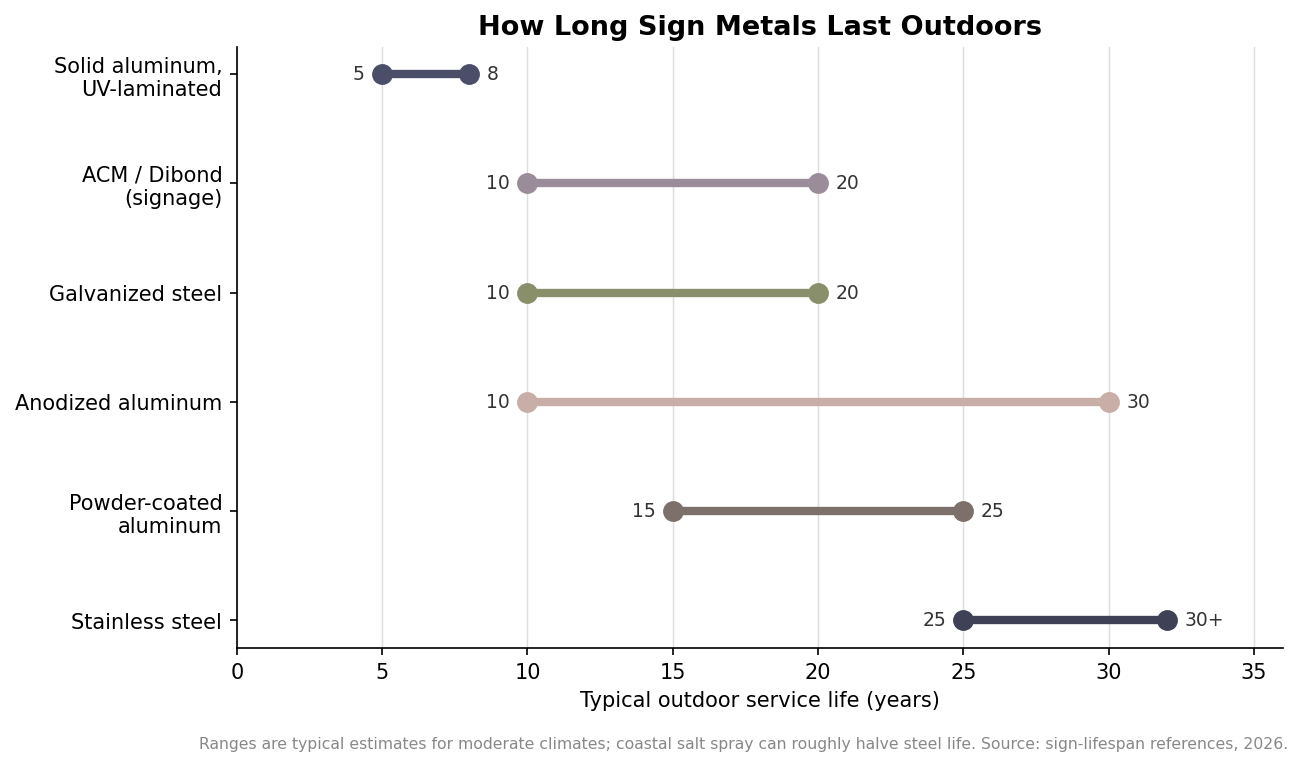
Lifespan is where these choices pay off or fail. Bare solid aluminum with a printed graphic and UV laminate typically holds up around 5 to 8 years outdoors before the graphics, not the metal, give out. A powder-coated aluminum sign commonly runs 15 to 25 years, and anodized aluminum can reach 10 to 30 years or more. Aluminum composite lands in the 10-to-20-year band, heavily dependent on edge sealing. Galvanized steel sits in a similar 10-to-20-year range, while stainless steel routinely exceeds 25 to 30 years with minimal corrosion. Finishes have their own clocks: a PVDF or Kynar finish carries a 15-to-20-year color-retention expectation, standard polyester powder coat runs 10 to 15 years and may need recoating every 7 to 10 in harsh sun, and ordinary reflective vinyl fades noticeably in just 3 to 7 years. These are typical estimates for moderate climates, and any of them can shorten in aggressive conditions.
Matching metal to environment, and the fasteners no one thinks about
Environment should drive the final call. Coastal salt spray can roughly halve the corrosion life of unprotected steel within 5 to 10 years, which tips the balance toward aluminum or 316 stainless anywhere near the ocean. High-wind and overhead locations argue for heavier aluminum gauges or a structural steel frame. Indoors, almost any metal lasts for decades, so the decision there is about appearance and weight rather than survival.
One detail quietly ruins otherwise good signs: the hardware. Bolting dissimilar metals together, such as untreated steel fasteners against aluminum, sets up galvanic corrosion that eats the joint from the inside. Specifying 316 stainless fasteners avoids it and is cheap insurance on a sign meant to last. Plan for light maintenance too: a rinse every three to six months, monthly in coastal zones, plus a recoat cycle every 8 to 15 years for painted surfaces, keeps a well-chosen metal sign performing to the top of its range instead of the bottom.